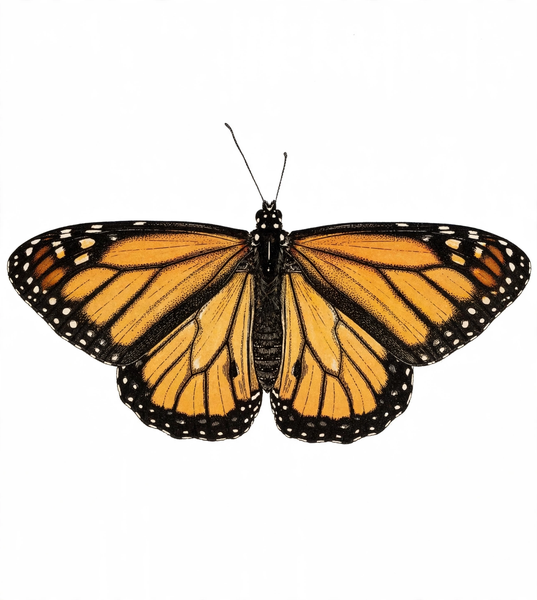
Monarch Migration: The 3,000-Mile Journey Back to the Same Forest in Mexico
Every fall, millions of monarch butterflies arrive in the mountains of central Mexico and settle onto the exact same groves of fir trees their ancestors used the year before. The miracle is this: the butterflies arriving have never been there. Not one of them has ever made the trip before.
No single monarch makes the round trip. The migration is a relay race run by four or five generations — and the final runner flies up to 3,000 miles to a forest it has never seen.
Leaving Mexico: the journey north begins in March
All winter, monarchs cluster on oyamel fir trees in the mountains of Michoacán, Mexico, in the Monarch Butterfly Biosphere Reserve. They hang in thick orange clusters, barely moving, living off the fat they stored for the journey south.
When spring warmth arrives in March, the survivors wake up, mate, and head north. These are the same butterflies that flew south in the fall — the only generation that lives long enough to make the trip twice. But they don’t get far. They lay their eggs on milkweed in Texas and the southern U.S., and then they die.
Their children hatch, grow, and keep flying north. Then their children do the same. All spring and summer, generation after generation leapfrogs northward — each one living just two to six weeks, each one pushing the frontier a little further, all the way to Canada.
The super generation: born to fly 3,000 miles
Then, as summer fades in late August and September, something changes. The monarchs born in the northern U.S. and Canada are different. Scientists call them the super generation (or the Methuselah generation).
Shorter days and cooler temperatures trigger reproductive diapause — their bodies pause sexual development so they don’t mate or lay eggs. Instead, all their energy goes into one thing: flying. While their parents lived a few weeks, these monarchs live eight to nine months.
They turn south and fly. Riding thermals and southbound breezes, they can cover 250 miles in a single day, and the whole journey takes about six weeks.
November: back to the same spot
By late October and November, they arrive in the oyamel fir forests of central Mexico — the same small groves where their great-great-grandparents clustered the winter before. Scientists discovered the overwintering site only in 1975, after decades of tagging butterflies and following the clues south.
How do they find a forest they’ve never visited? They navigate by the sun, adjusting for the time of day like a compass, and research suggests they may also sense Earth’s magnetic field. The full answer is still one of nature’s great mysteries — but the result is certain. Year after year, generation after generation, they return to the same trees.
They’ll cluster there all winter, wings closed, waiting for March — when the cycle begins again.
What this means for your garden
Host plant: Native milkweed. Every monarch generation needs it — it’s the only plant monarch caterpillars eat. Plant milkweed native to your area (here in Florida, swamp milkweed is a favorite), and skip tropical milkweed, which can disrupt the migration cycle.
Nectar plants: Fall nectar is migration fuel. Goldenrod, asters, and mistflower give southbound monarchs the energy to make the trip.
Even here in Florida, where many monarchs stay year-round, planting native milkweed and fall nectar supports both our resident monarchs and the travelers passing through. Every milkweed patch is a rest stop on a 3,000-mile relay.